Showing posts with label Sisi Xu. Show all posts
Showing posts with label Sisi Xu. Show all posts
Sunday, 25 November 2012
Annotated Bibliography
Annotated Bibliography
Cavna, Michael. 'MetaMaus': 'MAUS' creator Art Spiegelman reveals emotional journey to today's 25th-anniversary book. 2011.<http://www.washingtonpost.com/blogs/comic-riffs/post/metamaus-maus-creator-art-spiegelman-reveals-emotional-journey-to-todays-25th-anniversary-book/2011/10/03/gIQARhyIKL_blog.html>
This article tracks the journey of the Maus Series. From the three page underground comix in 1972, Maus I, Maus II and to winning the Pulitzer Prize. There will never be a 'Maus 3.' Also includes photo of Art taken by his daughter.
Comic creator Lamblek. Art Spiegelman. 2012.<http://www.lambiek.net/artists/s/spiegelman.htm>
This site is present visuals for some of his famous Art works. Dates to the Grand Prix in 2011. Site also gives detail about Spiegelman's own comix magazine Raw.
Directors Club. Art Spiegelman. 2006.<http://www.adcglobal.org/archive/hof/2006/?id=302>
This site gives some useful information about Art Spiegelman's recent life. Hall of Fame up to year 2006. Also include a photo of Art.
GradeSaver. Biography of Art Spiegelman. 2012. <http://www.gradesaver.com/author/art-spiegelman/>
The site gives a brief biography of Art Spiegelman. From his date of birth to year 1995 when he received honorary doctorate from Binghamton University in 1995.
Marcuse, Harold. Introduction about Maus. 2012. <http://www.history.ucsb.edu/faculty/marcuse/classes/33d/33dTexts/maus/MausResources.htm>
This site details the Timeline of Events in Maus and Art Spiegelman's Life.
ReligionFacts. The Swastika Symbol in Hinduism. 2012. <http://www.religionfacts.com/hinduism/symbols/swastika.htm>
The article gives a brief explanation to the Swastika symbol. Also presents symbol images used in hinduism.
The American-Israeli Cooperative Enterprise. Art Spiegelman. 2012 <http://www.jewishvirtuallibrary.org/jsource/biography/Spiegelman.html>
This site is a brief biography of Art Spiegelman detailing towards his adult life.

Symbolism in Maus
What's So Special About Art Spiegelman's MAUS and "Crossroads"?
 |
| (125) Maus I |
It's interesting because the Swastika is recognized as a derivative from the Hindu symbol. The symbol is used as a charm to bring good fortune. The Nazis adopted the sign for its indication of racial purity and superiority.
 |
| Swastika banner being hung for an Indian wedding, Mumbai. |
BY: Sisi Xu
------
ReligionFacts. The Swastika Symbol in Hinduism. 2012
<http://www.religionfacts.com/hinduism/symbols/swastika.htm>
Monday, 19 November 2012
Book Analysis
Abstract: Maus is the award winning piece of American comic artist Art Spiegelman. This paper discusses the style and methods used in the Postmodernism(1) Graphic memoir Maus I and analyzes its significance, purpose and theme.

_
__
 |
| Remind - (47) |
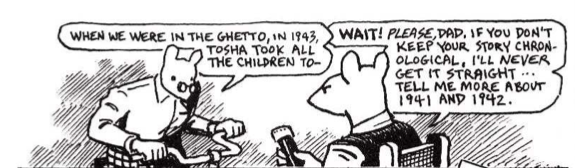 |
| Chronological Order - (82) |
____
 |
| Diary- (93) |
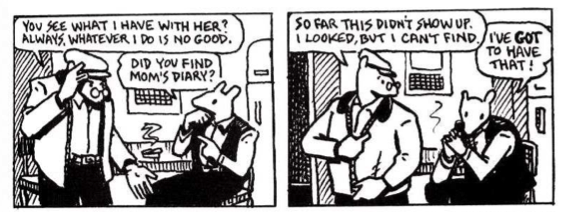 |
| Diary - (105) |
 |
| Need Diary - (158) |
 |
| Burned Diary - (159) |
____
 |
| 84 |
 |
| 39 |
--
___
 |
| 99 |
 |
| 100 |
 |
| 104 |
---
 |
| 46 |
Maus is like a carefully staged play that visualizes despair, betrayal and such actions reveals the human nature. Starting with Vladek family's attempt to avoid enrolling the army.(46) This might appear like a family caring situation, but placing their own safety prior to the nations is rather a selfish behaviour. Vladek was safe alright, but also extremely sick. At the time of war, allies should remain strong as a team.
 |
| 47 |
----
 |
| 113 |
The Vladek's family was discovered when hiding in the attic. (113) The family shared their food after realizing the thief was their own kind. Unfortunately, the intruder gave the hiding spot to Nazis. Exposing the location is inappropriate, but revealing after accepting the food becomes betrayal. Never mind about intruding to steal in the first place, everyone had a hard time, surviving was the most significant.
---
 |
| 23 |
Characterization played a crucial role enhancing the story. Character interactions and behaviours aid to define their personality. (23)
 |
| 24 |
Prologue begins with child Art crying to papa waiting for comfort and quickly cuts to "I hadn't seen him in a long Time - we weren't that close." (5,11)This raise the curiosity about father and son relationship and keeps the interest.
 |
| 5 |
 |
| 11 |
 |
| 69 |
 |
| 69 |
 |
| 159 |
----
At the end, Art turned away and whispered "Murderer." (159)This might explain Art's constant frustration towards Vladek because he is highly opinionated. Though the reason is still unknown, but could it be the case where Vladek killed someone? We do not know.
- -
Scene of Interest - the Battlefields
As a German solider, Vladek was scolded for having a cold gun, but when discovered by the Nazis he was in trouble because its hot. Ironic scene - there is more than one side to everything.
 |
| 48 |
 |
| 49 |
 |
| 50 By: Sisi Xu ------ Term: (1)Postmodernism: Postmodernism relies on concrete experience over abstract principles, arguing that the outcome of one's own experience will necessarily be fallible and relative, rather than certain or universal. |
Sunday, 4 November 2012
Maus Story Timeline
Maus: A Survivor's Tale
1906, October 11: Vladek Spiegelman born
1912, March 15: Anja Zylberberg born
1927: Vladek starts his first service in the Polish army
1937, February 14: Vladek and Anja marry (he is age 30, she 24)
1937, October: son Richieu is born in Sosnowiec
1939, August 24: Vladek is called to serve in the Polish army
September 1: Germany invades Poland
September 4: Germans enter Sosniwiec Vladek is arrested as a prisoner of war
September 28: Poland surrenders
December 23: Jewish property in Poland is confiscated Vladek and Anja's father lose their factories
1940, February : Vladek is released from the POW camp and sent to Lublin
1941, December : All Jews in Sosnowiec are forced to live in the ghetto section
1942, May 10-12: "Aktion" (deportation) of 1500 from Sosnowiec, includes Anja's parents
June: Jews deported from Sosnowiec to Auschwitz
August 12: Jews called to Sosnowiec stadium, then deported to Auschwitz
Vladek's parents are also deported and murdered in 1942
1943, Spring: all remaining Jews in Sosnowiec are sent to Srodula ghetto
Richieu is sent to Zawiercie with his aunt Tosha
Aug. 16: most Jews in Srodula are deported to Auschwitz
Vladek and Anja are in hiding
Aug. 26: Tosha poisons herself, Richieu, her daughter Bibi and her niece Lonia to avoid deportation
1944, January : remaining Jews in Srodula are murdered; Vladek and Anja are still in hiding
March: Vladek and Anja are sent to Auschwitz; quarantine til mid-May (II, 68)
May-Aug.: Vladek works in Auschwitz tin shop
Summer: Vladek sees Anja in Birkenau
Aug.-Oct.: Vladek works in Auschwitz shoe shop, then tin/metal working again
Sept/Oct: Anja is moved from Birkenau to Auschwitz
1945, Jan.: Vladek is marched to Gross Rosen (Anja, too, then to Ravensbrück)
Feb.: Vladek is sent by train to Dachau
April: Vladek is evacuated from Dachau
Apr. 29: Dachau is liberated
May 7: Germany surrenders
Summer: Vladek is in a US displaced persons camp in Garmisch-Partenkirchen he goes to Bergen-Belsen, learns that Anja is in Sosnowiec, and goes there to meet her
1946: Vladek and Anja move from Poland to Sweden; Vladek starts a business
- - - - - -
Source: Marcuse, Harold. Introduction about Maus. 2012.
BY: Sisi Xu
Saturday, 3 November 2012
Key concepts
KEY Concepts - Maus
"Maus books have been translated into over twenty five languages, and the work was chosen by the new york public library and the New York Times Book review as one of the 100 most significant books of the last century. "
- - - - -
Maus was based on the experiences of Art Spiegelman's parents as concentration camp survivors. He took this premise to a full-blown graphic novel, and drew from 1980 to 1986. In Maus, different races and nationalities are portrayed differently. Jews as mice and the Germans(Nazis) as cats(Katzies).
A precursor to Maus was first published in underground comic magazine called Funny Animals in 1972. The work was only three pages long, but includes most of the elements.
First volume of Maus was published in 1987, following with enormous critical and commercial success, and to this day it is widely considered to the among the best and most powerful of Holocaust- inspired works.
- - - - -
Maus consists of two primary narratives. The First is directed by Art's father, Vladek Spiegelman, who explained his experiences in the Holocaust to his son, through a series of interviews. The narratives begins pre-war Poland and tracks his life over a period of approximately ten years. From marriage to his wife, Anja, in 1937, through his experiences in Auschwitz, and to his immigration to Sweden after the war. The second narrative focuses on Art's interviews with his father, and their current life. Story also contains a minor narrative story. The short is his originally published story in 1972, which details the story of Art's mother's suicide.
The impact and complexity of Maus, is far greater than most work of this medium. Story explores the nature of guilt, and serves as a meditation on the effects of a major historical event - traumatic events of the Holocaust - on the lives of people who were born after it ended. Best known for their shifting graphic styles, formal complexity, and controversial content. With its complex themes and structure and and unconventional medium of a graphic novel. Maus in many ways rises above genre to become something completely unique. It is an amazing and lasting story that is destined to be a classic.
- - - - -
- - - - - -
 |
| 'MetaMaus' - 25th - anniversary 'Maus' compendium (Art Spiegelman - Pantheon Books) |
Photo reference.
Cavna, Michael. 'MetaMaus': 'MAUS' creator Art Spiegelman reveals emotional journey to toady's 25th- anniversary book.
BY: Sisi Xu
BY: Sisi Xu
Adult Life
Adult Life
 |
| Art Spiegelman |
Art Spiegelman moved to San Francisco from 1971 - 1975 where comix appeared. He moved back to NYC and began doing drawings and comics for the New York Times, village voice and playboy. Besides his cartooning career, Art Spiegelman edited several comix magazine. and became an instructor at the school of Visual Arts.
Spiegelman's career took flight with the publication of the first rendition of Maus in 1972. In 1979-1980 he co-founded RAW magazine, the acclaimed avant-garde, unconventional comics, with his wife, artist Françoise Mouly. In the pages of Raw, He helped reveal important Moriarty. For eleven years, Raw lavishly presented groundbreaking work by contemporary cartoonists.2
Spiegelman published Maus I in 1986 and Maus II in 1991 and received National book critics circle nominations for both. In 1992 he Won Special Pulitzer Prize for the masterful Holocaust narrative Maus.
Art Spiegelman lives in New York City with his wife and two children, Nadja and Dashiell. He received an honorary doctorate from Binghamton University in 1995.
 |
| "One work dominates what I have done," - Art Spiegelman (Photo by Nadja Spiegelman) |
Timeline
1970: Art publishes "Prisoner from Hell Planet" (reproduced in Maus)
1972: Art publishes "Maus" in Funny Animals (3 page comic)
1975: Art meets the woman he will marry, Françoise Mouly (b. 1955)
1978: Art Spiegelman starts drawing Maus
1979, Aug.: Art and Françoise spend time in the Catskill mountians (NY) with Vladek
1980: Art and Françoise start the avant-garde magazine RAW
Art begins drawing Maus, which is serialized in RAW
1982, Aug. 18: Vladek dies of congestive heart failure
1986: first volume of Maus published
1987: Art and Françoise's daughter Nadja born
1991: second volume of Maus published
1992-: Art starts working for the New Yorker (he resigns some time after 9/11/2001)
1992: Art wins a Pulitzer Prize for Maus
1992: son Dashiell born
1993-: Françoise works as art editor at the New Yorker
2004: Art publishes In the Shadow of No Towers
2005: Art begins publishing a comix format memoir, Portrait of the Artist as a Young !@##$%!, which incorporates some of his most significant early underground comix.
- - - - - - - - - - - - - - - - - - - - - - - -
The American-Israeli Cooperative Enterprise. Art Spiegelman. 2012
Comic creator Lamblek. Art Spiegelman. 2012
BY: Sisi Xu
Early Life
Early Life
to approx. age 20~
Brief Biography
Name: Art Spiegelman (or) Arthur Spiegelman
Born: 15 February 1048.
Place of Birth: Stockholm, Sweden.
"Art Spiegelman has, according to the LA Weekly, almost single-handedly brought comic books out of the toy closet and onto the literature shelves."
- - - - - - - - - - - - -
He left college two years after without a degree, following a brief but intense nervous breakdown and was hospitalized .
Spiegelman's early career began in 1966, working for Topps Gum Company. He stayed as creative consultant for almost twenty years(1966-1987) until a dispute over the ownership of his original artwork caused him to leave.
After leaving college in 1969 , he joined the underground comix movement. (1)
Timeline
1948, Feb. 15: Art Spiegelman is born in Stockholm
1951: Spiegelman family immigrates to US, Art grows up in Queens, New York
1965: Art attends the High School of Art and Design in Manhattan
1968, ca. March: Art has a brief but intense nervous breakdown & is hospitalized
May 21: Anja commits suicide after Art returns home
Art leaves Harpur college/SUNY Binghamton (major: art & philo)
- - - - - - - - - - - - - - - - - - - - - - - -
1. underground comix and the underground press
Late 1960s saw the emergence of underground comics, a new wave of humorous, hippie-inspired comic books that dealt with social and political subjects like sex, drugs, rock music and anti- war protest.
DirectorsClub. Art Spiegelman. 2006
GradeSaver. Biography of Art Spiegelman. 2012
BY: Sisi Xu
Subscribe to:
Posts (Atom)